
Why almost no memecoin gets back to its ATH
The peak comes fast and the comeback almost never does. We pull together the October 2026 data: how many days it takes to reach the ATH, how many tokens survive their first week at all, and why the way back grows faster than the loss. Figures whose source cannot be checked are clearly marked.
Key takeaways
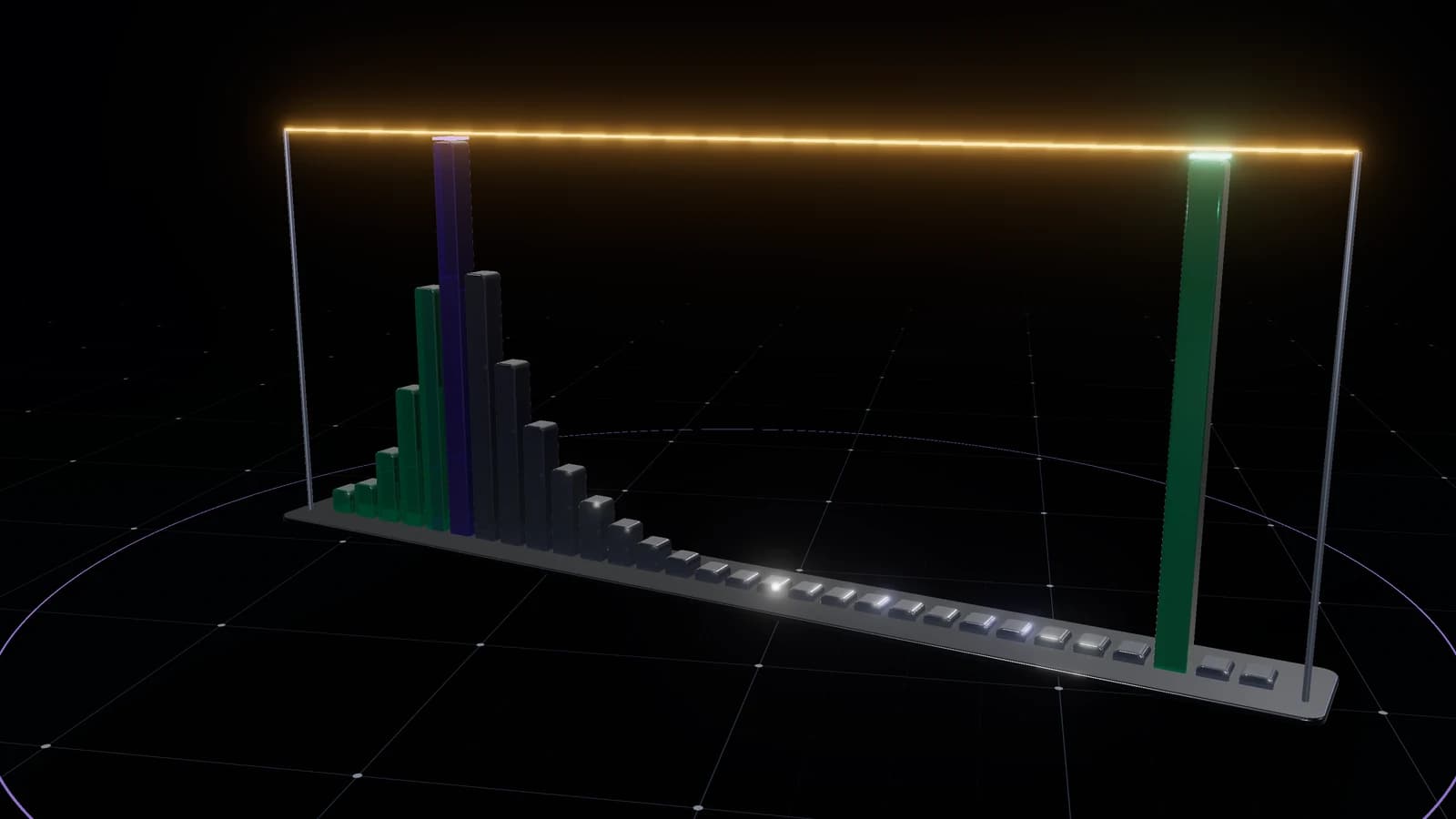
- According to TechFlow, citing Bloomberg, a memecoin reaches its ATH on average 17.2 days after its first trade, and 25% of tokens peak within 1.6 days. We could not find the Bloomberg original
- According to the same source, only about 3% of tokens ever beat their previous high
- According to Bitquery data, 79% of pump.fun tokens traded only on launch day, and about 1.5% had any trade in their fifth week
- A 90% drop needs a 900% rise to get back to the ATH. A 95% drop needs a 1900% rise
- Above the price after the peak sits the supply of people who bought higher and sell into every bounce
- Treat the ATH as history, not a target. Set your exit plan before you buy, not after the drop
The peak comes in days, not months[1][2]
The ATH, or all-time high, is the highest price a token has ever reached. According to TechFlow (16 October 2026), citing Bloomberg data, a memecoin reaches its ATH on average 17.2 days after its first trade. One token in four peaks within 1.6 days, about 38 hours after launch.
That means for a large share of tokens the best moment to sell passes before most people have even heard of them. Whoever finds a token through a post on X or a top gainers list often buys after the peak.
After the peak: a long slide and about 3% comebacks[1][2]
According to the same source, the median time for a token to lose 95% from its peak is 370 days. Only about 3% of tokens ever beat their previous high. These figures also come from the unverified dataset attributed to Bloomberg.
TechFlow also writes that speculative capital is not leaving the market but moving to prediction markets such as Polymarket and to AI-agent tokens. The article gives no figures to show this.
Most tokens do not even live to see day two[3][4]
The survival data is better described. Bitquery counted Solana tokens from 1 November 2025 to 7 October 2026. According to crypto.news (18 October 2026), 79% of pump.fun tokens traded only on launch day, about 1.5% had any trade in their fifth week, and only 0.2% had 10 or more trades in their fifth week. One token in 58 completed the migration to a full pool, the graduation.
On Meteora DBC, 51% of tokens traded only on launch day, and 1.9% had a trade in their fifth week. According to TokenPost (18 October 2026), in a sample of 8,984,141 pump.fun tokens, 43% of graduated tokens were still trading in their fifth week, against 1% of those that never graduated.
For most tokens the question of getting back to the ATH never comes up: after the first day there is nobody left to buy them.
The maths of a drop: the deeper it goes, the further the way back[1]
The percentage of a drop and the percentage rise needed to recover are not the same. After a drop you count the rise from a lower price, so the way back is always longer than the loss.
The figures are hypothetical. A token had its ATH at a US$1,000,000 market cap. After a 50% drop it is at US$500,000 and needs a 100% rise to get back. After a 90% drop it is at US$100,000 and needs a 900% rise. After a 95% drop it is at US$50,000 and needs a 1900% rise, twenty times its current value.
Why the price does not come back[2][3]
A memecoin has no revenue and no dividends. Its price depends only on whether new buyers keep arriving. Attention is highest at the peak and then moves on to the next tokens, thousands of which launch every day.
The first buyers, the dev, snipers and insiders, have an entry cost close to zero and sell at the peak with a profit. Everyone who bought near the ATH is then at a loss and often sells at the first bounce back to their entry price. That supply hangs over the chart and snuffs out each new attempt to rise.
Liquidity in the pool also falls after the peak. In a shallow pool even a small sale pushes the price down hard, and large holders find it ever harder to exit. That speeds up the slide and scares off new buyers. This is our analysis of how the market works, not a finding of the studies cited.
What this means before you buy[3][4]
The data does not say that no memecoin will rise. It says that buying in the hope of a return to the old peak is a bet on a rare case. It is better to treat the ATH as the token's history, not a price target.
- Check how long ago the peak was and how far below it the price is in percent
- Work out how many percent the price would have to rise to get back to the ATH
- Check the liquidity in the pool and whether there is still any trading
- Decide before you buy at what price you take a profit and at what price you cut a loss
- Do not buy more after a drop just because the token used to be higher
- Practise getting in and out with paper trading before you use real money
Check what stuck
A pass is 4 of 5 right answers.
Question 1 of 5
According to TechFlow, how many days after its first trade does a memecoin reach its ATH on average?
Sources
Primary material used to verify the information. A number beside a section points to the related source. A link is not an endorsement of the asset discussed.
- 01KuCoin News za TechFlow (2026-10-16): memecoiny osiągają ATH średnio po 17,2 dnia (dane przypisane Bloombergowi) [KuCoin News via TechFlow (2026-10-16): meme coins average 17.2 days to ATH (figures attributed to Bloomberg)]
- 02TechFlow (2026-10-16): Meme Coins Reach Peak in an Average of 17.2 Days
- 03crypto.news (2026-10-18): dane Bitquery o przeżywalności tokenów z pump.fun i Meteora DBC [crypto.news (2026-10-18): Bitquery survival data for pump.fun and Meteora DBC tokens]
- 04TokenPost (2026-10-18): tokeny z pump.fun w piątym tygodniu po starcie [TokenPost (2026-10-18): pump.fun tokens in their fifth week after launch]
Spotted an error or something out of date? Write to kontakt@memecoiny.pl. How corrections work